
In Alberta, the executor and trustee are often the same person, while the two roles are governed by different laws and last very different lengths of time. This guide explains how Alberta allocates executor and trustee duties, what each role involves, and how to decide who should take on each job in your Will.
The Duties of Executors and Trustees
In Alberta, an executor (now legally called a personal representative under the Estate Administration Act) settles the whole estate: gathering assets, paying debts and taxes, and distributing what is left.
A trustee manages specific property held in trust for a beneficiary, often for years, under the Will and the Trustee Act. The executor’s job ends when the estate is distributed; a trustee’s job can begin and continue until a child turns 25 or a trust ends.
Executor, Personal Representative or Trustee?
Much of the confusion comes from vocabulary. Alberta modernised its estate law in two steps: the Wills and Succession Act came into force on February 1, 2012, and the Estate Administration Act followed on June 1, 2015. Together they replaced “executor,” “executrix,” and “administrator” with a single term: personal representative.
“Executor” is still used every day, including by lawyers, and older Wills still use it. It means the same thing. The word “trustee,” on the other hand, is used in at least five different settings in Alberta, and they are not interchangeable.
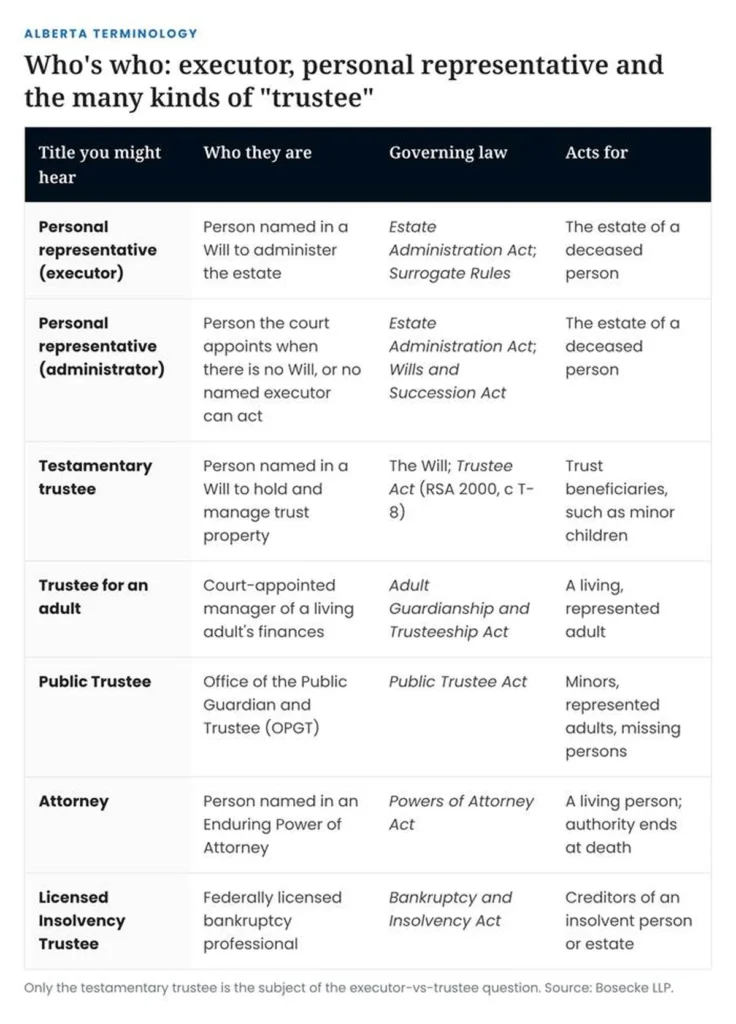
Table comparing executor, administrator, testamentary trustee, trustee for an adult, Public Trustee, attorney and Licensed Insolvency Trustee in Alberta.
One point catches many families off guard: your attorney under an Enduring Power of Attorney has no authority after you die. From the moment of death, only your personal representative can deal with your property. See our Power of Attorney page for how the two documents work together.
Scope and Duration of Trustee and Executor Roles
Both trustees and executors are fiduciaries. Each must act honestly, in good faith, and in the best interests of the beneficiaries, never for personal gain. The difference is scope and duration.
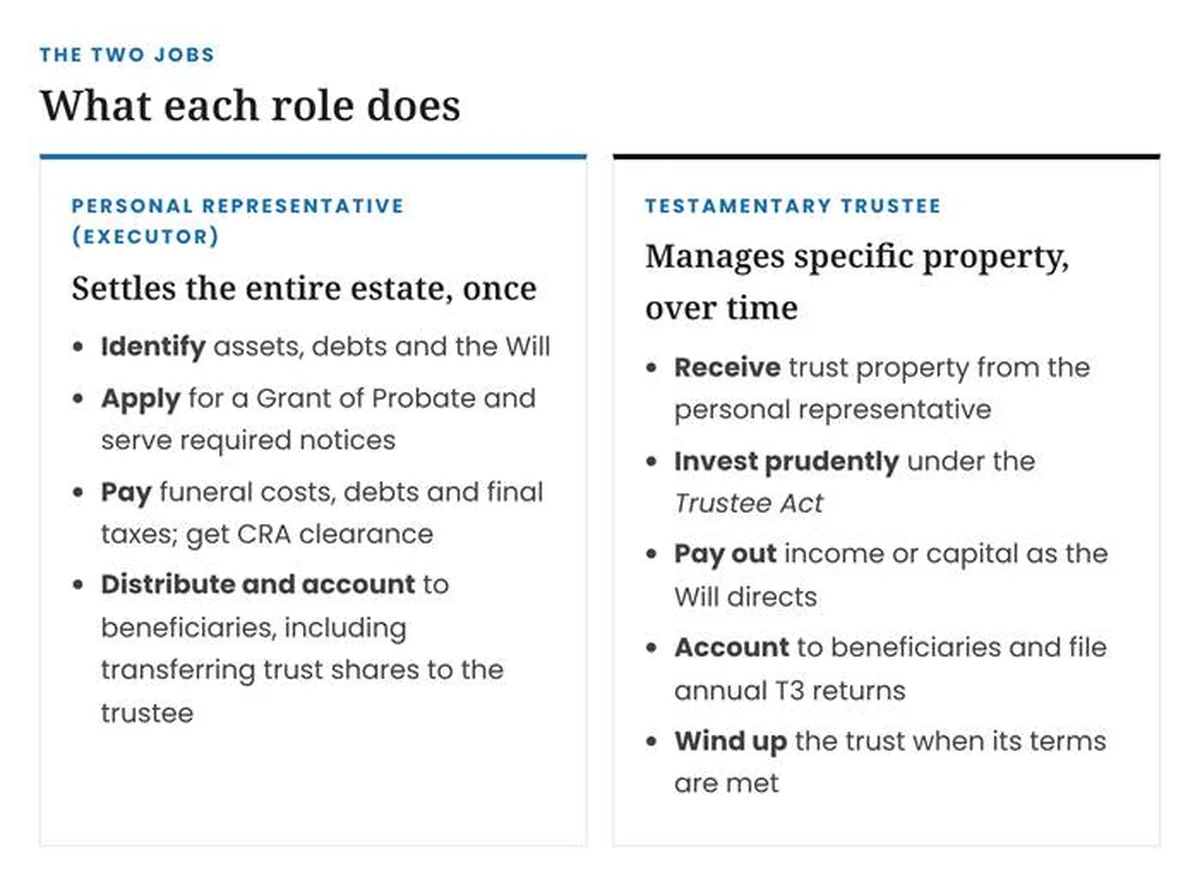
Side-by-side cards listing the duties of a personal representative and a testamentary trustee in Alberta.
The Personal Representative (executor)
Schedule 1 of the Estate Administration Act lists the personal representative’s core tasks. In practice, they fall into four groups:
• Identify the estate’s assets and debts, and locate the Will.
• Administer and manage the estate, including applying for a Grant of Probate (or Administration) at the Court of King’s Bench where required, and serving notice on beneficiaries, family members and, where applicable, the Public Trustee.
• Pay funeral costs, debts and the deceased’s final taxes, then obtain a CRA clearance certificate.
• Distribute and account to beneficiaries, including transferring trust shares to the trustee.
For a step-by-step walkthrough, read What Are the Duties of an Executor When Probating an Estate in Alberta?
The Testamentary Trustee
A testamentary trustee’s powers come from the trust terms in the Will, backed by the Trustee Act. Typical duties:
• Receive the trust property from the personal representative.
• Invest prudently. Alberta’s Trustee Act sets a prudent-investor standard unless the Will says otherwise.
• Pay out income or capital as the Will directs, for example, for a child’s education or a disabled beneficiary’s care.
• Keep records, account to beneficiaries, and file annual T3 trust tax returns.
• Wind up the trust when its terms are met, such as a child reaching a set age.
Side-By-Side Analysis of What Each Role Involves
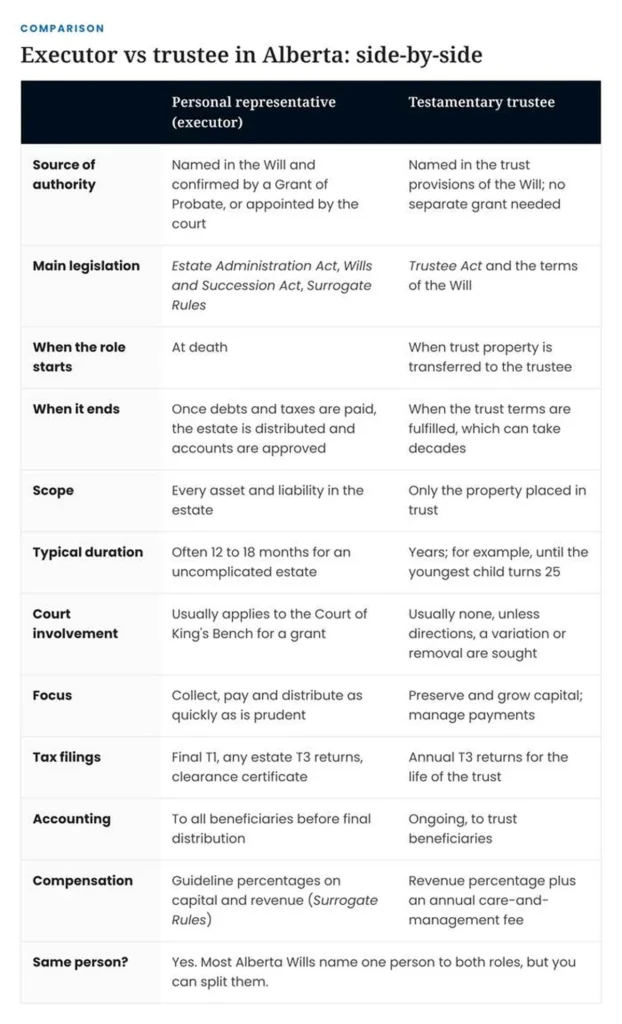
The above is a comparison table of executor vs trustee in Alberta covering authority, legislation, start and end of role, scope, duration, court involvement, taxes, accounting and compensation.
The personal representative has broader authority over the estate as a whole; the trustee has deeper, longer-term control over a defined pool of property. The personal representative is responsible for getting the trust property into the trustee’s hands and can request an accounting from the trustee as part of finalizing the estate.
How Trustees and Executors Combine to Enforce the Will
The roles overlap only briefly. This is the order the steps usually occur in Alberta when a Will creates a trust.
1. Death and first steps. The personal representative locates the Will, arranges the funeral, secures property, and notifies banks, insurers, and pension plans.
2. Apply for a grant. The personal representative files the probate application with the Court of King’s Bench and serves notices on beneficiaries, family members and the Public Trustee if a beneficiary is a minor or represented adult.
3. Wait out the claim period. Family members have six months from the grant to bring a family maintenance and support claim under the Wills and Succession Act. A personal representative should not distribute before then without consent or a court order.
4. Pay debts and taxes. File the deceased’s final return, pay creditors, and obtain a CRA clearance certificate before final distribution.
5. Transfer trust shares to the trustee. Gifts left outright go directly to beneficiaries. Shares left in trust go to the trustee, who signs a receipt.
6. Manage the trust. The trustee invests, makes payments as the Will directs, keeps records, and files a T3 return each year.
7. Wind up. The trustee distributes the remaining capital when the trust’s terms are met and gives a final accounting.
An Edmonton Example
Illustrative scenario. Maria, a widowed Edmonton homeowner, leaves her estate equally to her two children, aged 12 and 16. Her Will names her brother as personal representative and creates a trust holding each child’s share until age 25, with her sister as trustee.
Her brother applies for probate, sells the house, pays the mortgage balance and taxes, waits out the six-month claim period, then transfers each child’s share to the trust. His role then ends.
Her sister invests the funds, pays for tuition and living costs as the Will allows, files T3 returns annually, and releases each share as the children turn 25. Her role could run for 13 years.
Had Maria’s Will left the children’s shares outright with no trust, each share would typically be held by the Office of the Public Guardian and Trustee until the child turned 18, and then paid to them in full. Naming a trustee and choosing the age is how parents keep that decision in the family.
Should One Person be Both Executor and Trustee?
Naming the same person is common and often sensible. Splitting the roles can be better when the trust will last a long time or the skills required differ.
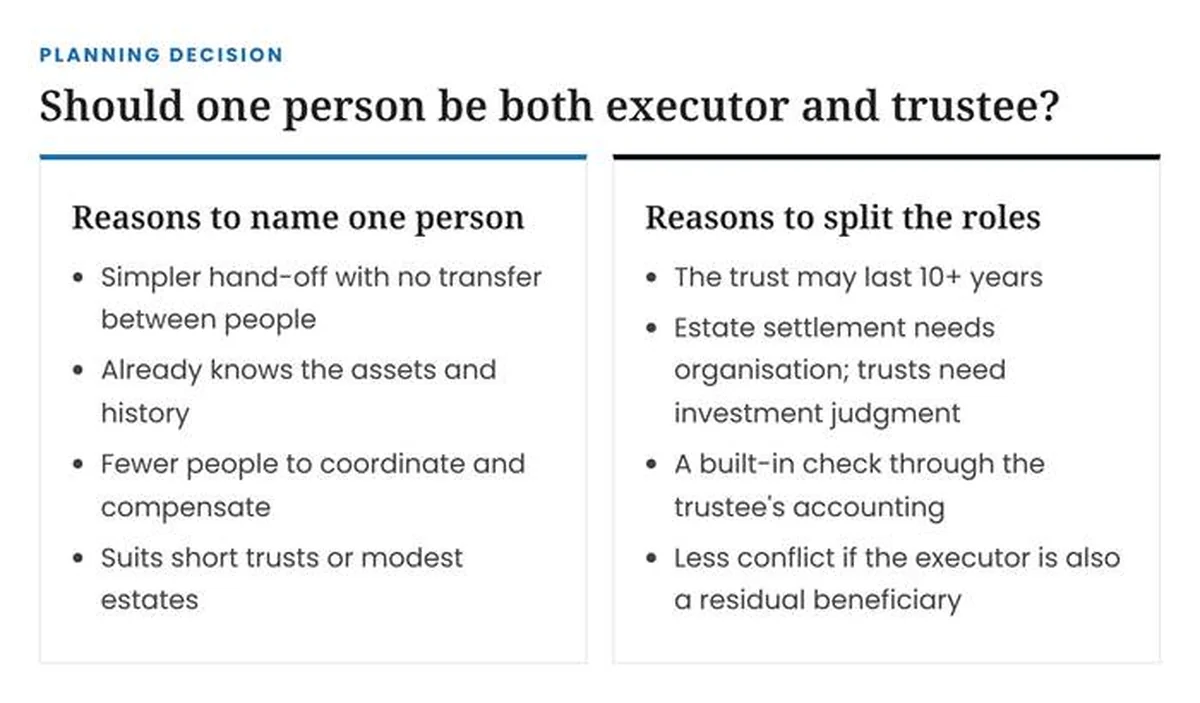
Whichever you choose, name at least one alternate for each role. If no named person can or will act, someone must apply to the court, which adds time and cost.
Compensation and costs in Alberta
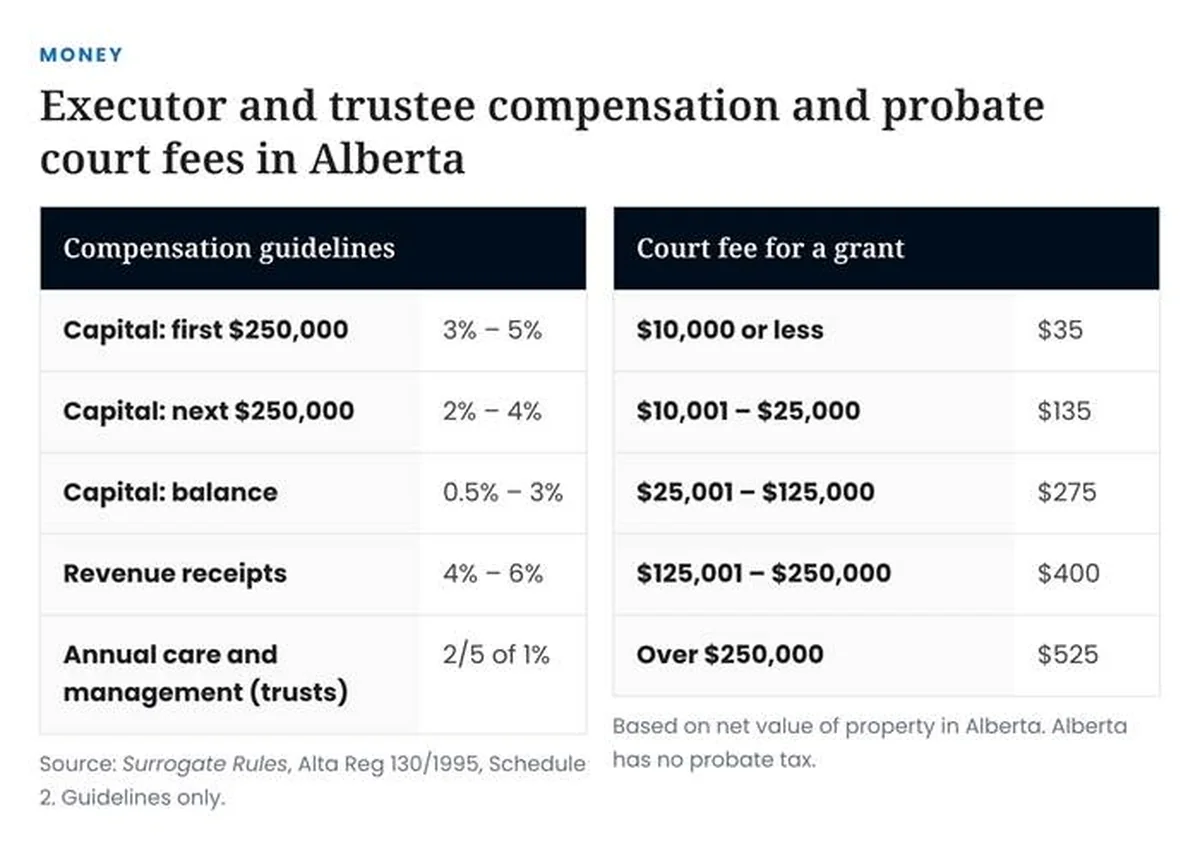
Both personal representatives and trustees are entitled to fair and reasonable compensation unless the Will sets a different amount. Schedule 2 of Alberta’s Surrogate Rules provides guidelines. These are starting points, not fixed rates: the actual amount depends on the estate’s size, complexity, time spent, and results, and beneficiaries may approve or challenge the claim.
Questions to Consider When Selecting Trustees and Executors
Ask these questions about each candidate before naming a trustee or executor in your Will.
• Are they at least 18 and likely to be capable for as long as the role lasts?
• Do they live in Alberta? Non-residents can act, but the court may require a bond, and practical tasks become harder from a distance.
• Are they organised, responsive and comfortable with paperwork and deadlines?
• For a trustee: are they comfortable with investing, or willing to hire advice?
• Do they get along with the beneficiaries, and could their own interests conflict with the trust’s?
• Have you named alternates for both roles?
• Would a trust company or professional be a better fit for a complex or long-term trust?
Our Estate Planning Checklist for Alberta Families covers the rest of your plan.
Answers to Common Questions About Trustees
Does a trustee have more power than an executor in Alberta?
No. They hold different powers over different property. The personal representative has authority over the whole estate while it is being settled. The trustee has authority only over the trust property, but that authority can last much longer and often includes discretion over when and how much to pay beneficiaries.
Is an executor the same as a personal representative?
Yes. Since the Wills and Succession Act (2012) and Estate Administration Act (2015), Alberta law uses “personal representative” for both executors named in a Will and administrators appointed by the court. An older Will that names an “executor” is still valid, and that person acts as the personal representative.
What are executor fees in Alberta?
The Surrogate Rules guidelines suggest 3% to 5% on the first $250,000 of capital, 2% to 4% on the next $250,000, 0.5% to 3% on the balance, and 4% to 6% of revenue receipts. Courts treat these as guidelines. A Will can also set a specific fee or say that no fee is payable.
Can an executor withdraw money from the deceased’s bank account?
Only for estate purposes, and usually only once the bank is satisfied of their authority. Many banks will pay funeral invoices directly or release small balances on a Will and death certificate under their own policies, but larger amounts typically require a Grant of Probate. Estate money must never be mixed with the personal representative’s own funds; open a separate estate account.
Who cannot act as an executor in Alberta?
A person under 18 cannot act, and neither can someone who lacks the mental capacity to manage the estate. The court also has discretion to refuse or remove a personal representative who is unsuitable, for example where there is a serious conflict of interest. Non-residents can act, though the court may require a bond.
Can the executor also be a beneficiary?
Yes, and it is very common. The personal representative must still treat all beneficiaries even-handedly and keep full records, because a beneficiary-executor’s decisions are more likely to be questioned.
What happens if my Will has no trust for my minor children?
A minor cannot receive an inheritance directly. Without a trust, the share is typically held by the Office of the Public Guardian and Trustee until the child turns 18, when it is paid out in full. A testamentary trust lets you choose the trustee, the age of distribution and how the money can be used before then. Learn more in The Complete Guide to Creating a Will in Alberta.
Can I refuse to be an executor or trustee?
Yes. A named personal representative can renounce, ideally before taking any steps in the estate; once you start acting, stepping back requires the court’s involvement. A trustee can decline before accepting the trust, or later retire under the Trustee Act or with court approval.
How long does an executor have to settle an estate in Alberta?
There is no fixed deadline, but the personal representative must act with reasonable speed. The “executor’s year” is a common rule of thumb, not a legal limit. In practice, the six-month family maintenance claim window and the wait for a CRA clearance certificate mean most estates take longer than a year.
Can a trustee or executor be removed?
Yes. A beneficiary or other interested person can apply to the Court of King’s Bench to remove a personal representative or trustee who is not performing their duties, has a conflict, or is acting against the beneficiaries’ interests. These disputes fall under estate litigation.
What trust helps a beneficiary who receives AISH?
A fully discretionary trust, often called a Henson trust, lets a trustee support a beneficiary with a disability without the inheritance counting as the beneficiary’s own asset for income-tested benefits such as AISH. Choosing the right trustee is especially important here, because the trustee decides every payment.
Named as an Executor or Trustee, or Planning your own Will? Schedule a Free Consultation

Since 1988, Bosecke LLP has helped Alberta families draft wills with the right trust structure and guided personal representatives through probate step-by-step. We explain your options with clarity, and we can assist in Tagalog, Punjabi, and Hindi.
Call (825) 535-0522 or schedule your free estate planning consultation to analyze your legal options when coordinating your estate.