
To create a valid will in Alberta, you must be at least 18 years old, of sound mind, and either sign a written document in the presence of two witnesses or handwrite and sign a holograph will entirely in your own hand. Alberta’s Wills and Succession Act governs these requirements, and getting any part of the process wrong can mean your estate is distributed under intestacy rules rather than according to your wishes.
This guide covers what a will must include, the legal requirements for validity, the different types of wills recognized in Alberta, and the most common mistakes that lead to disputes.
What is a Will?
A will is a legal document that directs how your property and assets will be distributed after your death. Under Alberta’s Wills and Succession Act, your will also lets you name your personal representative, commonly called an executor, who will be responsible for administering your estate, paying outstanding debts, and distributing assets to your beneficiaries. If you have minor children, your will also designates a guardian for them.
Without a valid will, you die “intestate,” and Alberta’s default intestacy rules decide who inherits your estate. Those rules follow a fixed formula based on your family relationships and do not account for blended families, close friends, charities, or personal wishes that fall outside the standard structure. This is one of the main reasons our estate planning guide recommends a will as the foundation of any estate plan.
Legal Requirements for a Valid Will in Alberta
Alberta recognizes two main types of wills, and each has its own formal requirements.
Formal Wills
A formal will, typically prepared with legal assistance, must meet the following requirements:
| Requirement | Detail |
| Testator’s Age | Must be at least 18 years old (with limited exceptions for minors who are married, in the military, or have a court order). |
| Mental Capacity | The testator must be of sound mind—meaning they understand the nature of the document, the extent of their property, and the individuals who might reasonably have a claim on their estate. |
| Written Form | The Will must be a written document (it can be typed or handwritten, though purely handwritten ones are known as holographic Wills). |
| Signature | The testator must sign the Will in a manner that clearly shows the intention to give effect to the document as their Will. |
| Witnesses | The Will must be signed or acknowledged by the testator in the presence of two witnesses who are both present at the exact same time. |
| Witness Signatures | Both witnesses must also sign the Will in the presence of the testator. |
| Witness Restrictions | A witness must be at least 18 years old. While a Will remains valid if a beneficiary (or their spouse/adult interdependent partner) acts as a witness, doing so generally voids the specific gift made to that person. |
Minors under 18 can make a valid will only in specific circumstances, such as being legally married, being in an adult interdependent relationship, being an active member of the Canadian Armed Forces, or having obtained a court order.
Holograph Wills
Alberta is one of the provinces that recognizes holograph wills. Under Section 16 of the Wills and Succession Act, a holograph will is entirely written and signed in the testator’s own handwriting, with no witnesses required.
Because there are no witnesses to confirm the circumstances of signing, holograph wills are more vulnerable to legal challenge, particularly around questions of capacity or undue influence. They can be a reasonable option in an emergency, but they are not a substitute for a properly drafted formal will as part of your ongoing estate plan.
Digital and Electronic Signatures
Alberta currently requires a physical, handwritten signature on both formal and holograph wills. Electronic or digital signatures are not accepted for the purpose of executing a will, so any will you create must be signed on paper.
What Should Be Included in Your Will
A well-drafted will typically addresses:
- Appointment of an executor, along with at least one alternate in case your first choice is unable or unwilling to act
- Distribution of your estate, including specific gifts and the division of the remainder among your beneficiaries
- Guardianship of minor children, naming who will care for them if both parents are unavailable
- Instructions for digital assets, such as online accounts, if applicable
- A residue clause that directs where any assets not specifically mentioned should go
- Contingency planning, addressing what happens if a beneficiary predeceases you
Leaving any of these areas unaddressed does not necessarily invalidate your will, but it can create ambiguity that leads to disputes or unintended results during administration.
Common Mistakes That Lead to Will Disputes for Alberta Residents
- Using an improperly witnessed will
If a formal will is not signed by two qualified witnesses who are present at the same time, it may be invalid, leaving your estate to pass under intestacy rules.
- Naming a beneficiary as a witness
Naming a beneficiary as a witness can void that person’s gift, even if the rest of the will remains valid. If the Court is satisfied that you, as the testator, genuinely intended to make the gift and that the witness exerted no undue influence, the gift will be upheld
- Failing to update the will after major life events
Marriage, divorce, the birth of children, and significant changes in assets are common reasons to revise your will.
- Leaving vague or contradictory instructions
Not providing explicit instructions can force an executor or the court to interpret your intentions rather than carry them out.
- Overlooking assets that pass outside the will
Ensure your will considers assets such as jointly held property or accounts with a named beneficiary, which pass outside the will distribution process.
How a Will Fits Into a Complete Estate Plan
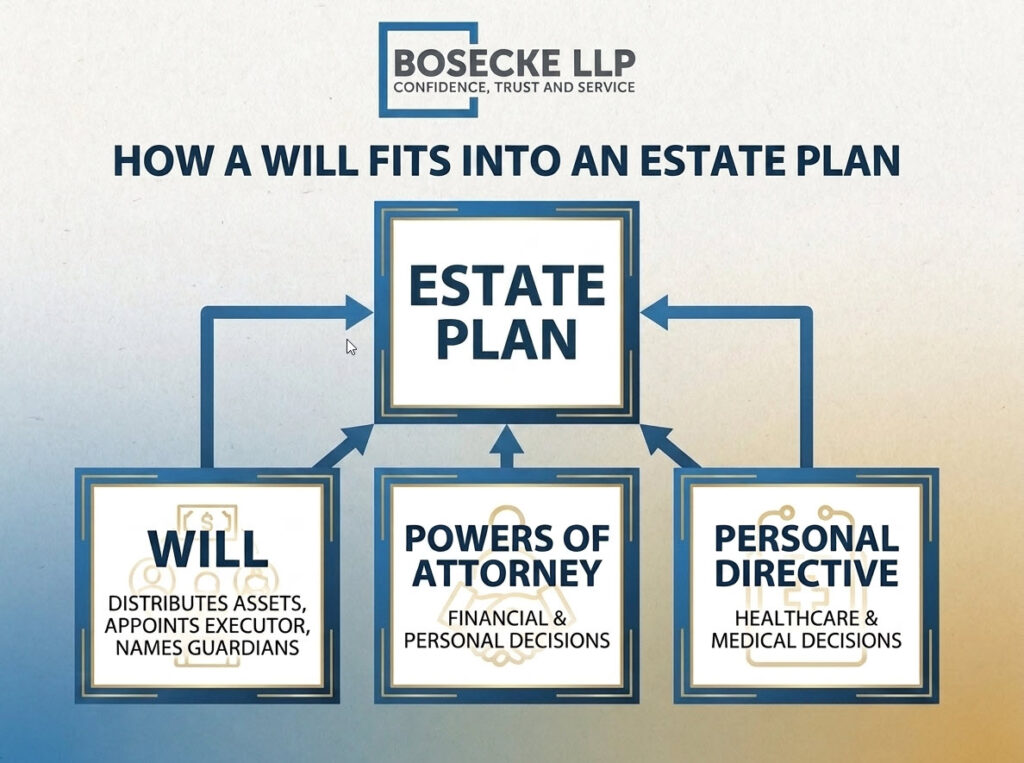
A will is the foundation of estate planning, but it only takes effect after death. A complete plan generally also includes an Enduring Power of Attorney for financial decisions and a Personal Directive for personal and health care decisions should you be unable to communicate your wishes.
Our wills and estate lawyers help Alberta residents put all three documents in place as part of a comprehensive estate plan, ensuring your future wishes are documented and your family protected for the long term.
Create Your Will With Confidence – Schedule a Free Will Review Consultation
Creating a will is one of the most important steps you can take to safeguard your loved ones and ensure your assets are allocated according to your wishes.
Whether you are drafting your first will or updating a document that no longer reflects your wishes, our team at Bosecke Law LLP can guide you through the process from start to finish. Contact us today to schedule a consultation.
Creating a Will in Alberta – Answers to Your Frequently Asked Questions
Do I legally need a will in Alberta?
No, creating a will is voluntary. However, if you die without one, Alberta’s intestacy rules determine who inherits your estate, and the outcome may not reflect your actual wishes, particularly if you have a blended family, unmarried partner, or want to leave assets to a charity or friend.
How old do I have to be to make a will in Alberta?
You generally must be at least 18 years old. Exceptions exist for minors who are legally married, in an adult interdependent relationship, active members of the Canadian Armed Forces, or who have obtained court permission.
How many witnesses do I need for a will in Alberta?
A formal will requires two witnesses, each at least 18 years old, who must be present together when you sign and must also sign the will themselves. A holograph will, which is entirely handwritten and signed by the testator, does not require any witnesses.
Can I write my own will without a lawyer?
Yes, Alberta recognizes holograph wills that you can write entirely by hand without a lawyer or witnesses. However, handwritten wills are more prone to legal challenges and interpretation disputes, so they are generally best reserved for emergencies rather than long-term planning.
What happens if I die without a will in Alberta?
You are considered to have died intestate, and your estate is distributed according to a fixed formula set out in the Wills and Succession Act, based on your surviving spouse, adult interdependent partner, and relatives. This formula does not account for personal wishes, unmarried partners in some circumstances, or friends and charities.
Can a beneficiary witness my will?
A beneficiary can technically witness a formal will, but doing so generally voids that beneficiary’s gift under the will, even though the rest of the document remains valid. It is best practice to use witnesses who are not named as beneficiaries.
How often should I update my will?
Review your will after any major life event, including marriage, divorce, the birth or adoption of a child, a significant change in assets, or the death of a named executor or beneficiary. Even without a major event, reviewing your will every few years helps ensure it still reflects your current wishes.
This article is provided for general informational purposes and does not constitute legal advice. For guidance specific to your situation, speak with our estate planning team.