
Whether you are starting a family, building a business, navigating a blended family, or approaching retirement, understanding the mechanics of estate planning gives you the power to protect what matters most.
Establishing a comprehensive and clear estate plan is one of the most compassionate and responsible things you can do for yourself and your loved ones. Your estate plan should provide your relatives with absolute clarity on your wishes to minimize family conflict and ensure your assets are allocated precisely according to your instructions.
This guide to Alberta estate planning explains the essential documents, smart strategies, and unique aspects of provincial law you need to understand before putting your plan into action.
Essential Estate Planning Documents
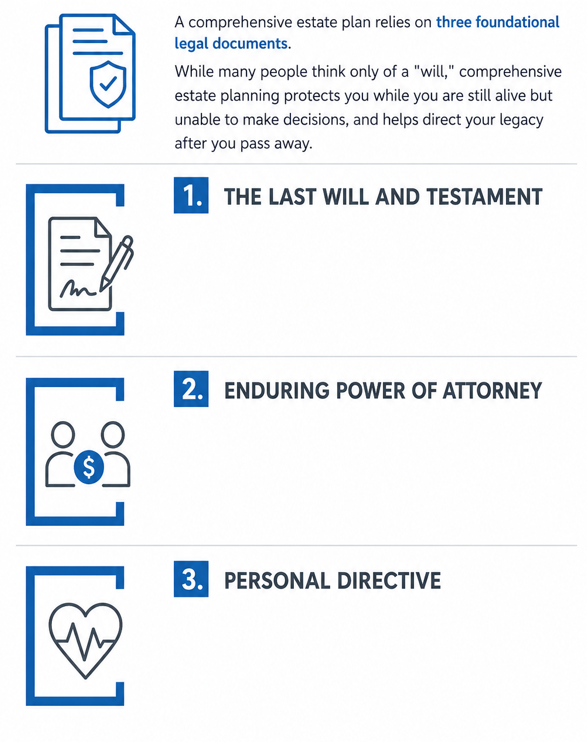
A comprehensive estate plan relies on three foundational legal documents. While many people think only of a “will,” comprehensive estate planning protects you while you are still alive but unable to make decisions, and helps direct your legacy after you pass away.
1. The Last Will and Testament
Your will is the bedrock of your estate plan. It explicitly outlines how your assets (your estate) will be distributed upon your death and, crucially, names the Personal Representative (often called an executor) who will manage the administrative process. If you have minor children, your will is also where you designate a legal guardian to care for them.
Without a valid will, provincial legislation dictates how your assets are divided, which may not align with your personal wishes and can severely complicate matters for your grieving family.
2. Enduring Power of Attorney
What happens if an accident or illness leaves you temporarily or permanently unable to manage your finances?
An Enduring Power of Attorney is a legal document that allows you to appoint someone you deeply trust (your attorney) to make financial, real estate, and legal decisions on your behalf. The term “enduring” means that this authority continues, or specifically triggers, if you lose mental capacity. Without an Enduring Power of Attorney, your loved ones might be forced to apply to the court for a formal trusteeship order, which is a lengthy, stressful, and expensive process.
3. Personal Directive
While a Power of Attorney covers your finances, a Personal Directive covers your health and personal care. Often referred to as a “living will” in other jurisdictions, this Alberta document appoints an agent to make medical and personal decisions for you if you become incapacitated.
Personal Directives include authorizing medical treatments, deciding where you will live, and specifying your end-of-life care preferences.
Having a clear Personal Directive in place spares your family from the heavy burden of guessing what you would have wanted during an emotional crisis.
Smart Estate Planning Strategies for Albertans
Once you have your core documents drafted, it is time to look at broader strategies that can maximize the value of your estate, protect your wealth, and minimize friction among your heirs.
- Minimizing Tax Burdens
Alberta has some of the lowest surrogate court (probate) fees in Canada. Fees are currently capped at $525 for estates valued over $250,000. However, a death can still trigger significant income tax liabilities. The Canada Revenue Agency generally treats all your capital property as if it were sold at fair market value immediately before your death.
Strategic planning, such as utilizing tax-free rollovers to a surviving spouse or carefully planning the disbursement of RRSPs, can save your estate tens of thousands of dollars in capital gains and income taxes.
- Utilizing Trusts
Trusts are not just a tool for the ultra-wealthy; they are highly practical mechanisms for control and protection. Potential trust vehicles include:
- Testamentary Trusts: Created within your will, these take effect after you pass away. They are highly effective for managing and staggering inheritances for minor children, protecting beneficiaries from themselves, or providing for individuals with disabilities without clawing back their provincial support.
- Spousal Trusts: Particularly useful in blended families, a spousal trust ensures your current spouse is financially supported during their lifetime, but guarantees the remaining capital ultimately passes to your children from a previous relationship.
- Holding Property in Joint Tenancy
If you co-own real estate or hold shared bank accounts in “joint tenancy with the right of survivorship,” the ownership automatically transfers to the surviving owner upon your death.
The asset does not form part of your estate, meaning it entirely bypasses the probate process. Joint tenancy is different from “tenancy in common,” where your share of the property remains in your estate and is subject to probate.
- Strategic Beneficiary Designations
Assets such as life insurance policies, RRSPs, RRIFs, and TFSAs allow you to name a direct beneficiary. When you do this, the proceeds of these assets bypass your estate entirely. They do not pass through your will, are entirely shielded from probate, and are paid out to your heirs within a consolidated timeframe.
Understanding Alberta Estate Planning Laws
Alberta legislation governs how estates, property, and dependents are handled. Before finalizing your plan, you must ensure your wishes don’t inadvertently violate provincial law.
The Wills and Succession Act (WSA)
This is the primary legislation governing wills, intestacy, and dependent support in Alberta. The WSA mandates your legal and moral obligation to adequately provide for your dependents. If you attempt to completely disinherit a spouse, an Adult Interdependent Partner (the Alberta legal term for a common-law spouse), a minor child, or an adult child unable to earn a living due to a disability, they have the legal right to challenge your will in court for family maintenance and support.
Dower Rights
If you are legally married and own a home in your name alone, but either you or your spouse has ever lived in it, the Alberta Dower Act applies.
The Dower Act grants a surviving spouse a “life estate” in the homestead. This means they have the legal right to live in that home for the rest of their lives, even if your will leaves the property to someone else. You cannot simply bypass your spouse’s Dower rights without their explicit, correctly witnessed, written consent.
The Impact of Marriage and Divorce
Alberta law has modernized regarding relationship changes. Getting married does not automatically revoke a previously existing will.
However, if you get formally divorced (or have been separated from an Adult Interdependent Partner for more than a year), any gifts left to that ex-partner in your will, or their appointment as your executor, are automatically revoked. They are legally treated as if they had predeceased you.
Estate Planning in Alberta: Frequently Asked Questions
What happens if I die without a will in Alberta?
If you die intestate (without a will), your estate is divided strictly according to the Wills and Succession Act. Typically, if you have a spouse and all your children are with that spouse, your spouse inherits everything. If you have children from a previous relationship, the estate is divided proportionally between your spouse and your children.
If you have no immediate family, the estate assets transfer to parents, siblings, or other blood relatives.
Are there inheritance taxes or “death taxes” in Alberta?
No, Canada does not have an inheritance tax. However, your estate must file a final income tax return. The Canada Revenue Agency (CRA) treats all your assets as if they were “sold” at fair market value immediately before your death, which can trigger capital gains taxes on things like a family cabin or an investment portfolio.
How often should I update my estate plan?
A good rule of thumb is to review your estate plan every three to five years to ensure it still reflects your wishes.
You should update your estate immediately following major life events, such as a marriage, divorce, separation, the birth or adoption of a child, the death of a named executor or beneficiary, or a significant change in your overall net worth.
Who should I choose as my Executor?
You should choose someone trustworthy, highly organized, and financially responsible. Managing an estate is a demanding job that can take a year or more to complete. You can choose a spouse, adult child, trusted friend, or even a professional trust company.
What happens to my digital assets?
Your digital footprint (social media, online banking, cryptocurrency) is part of your estate. It is highly recommended to include a specific digital assets clause in your Will and keep a secure, updated list of your accounts and passwords for your Executor.
Bosecke LLP – Estate Planning Lawyers in Edmonton
Estate planning is not a one-size-fits-all process. A simple wording oversight or a misunderstanding of Alberta’s laws can lead to years of legal battles, fractured family relationships, and unnecessary financial losses.
You do not have to navigate this complex terrain alone. At Bosecke LLP, our experienced Edmonton estate planning lawyers are dedicated to helping you protect your legacy and provide absolute peace of mind for your loved ones.
We take the time to understand your unique family dynamics, financial situation, and long-term goals. Whether you need a foundational will, complex trust structuring, guidance on business succession, or assistance navigating probate, we provide practical, straightforward, and friendly legal advice tailored to your life. Secure your legacy with confidence. Contact Bosecke LLP today to schedule a consultation with our Edmonton estate planning team and take the first critical step toward protecting your loved ones for the years ahead.