
Estate planning conversations in Alberta almost always start with a will. But more and more Edmonton families are asking a follow-up question: should I also set up a living trust? It’s a smart question — and the honest answer is “it depends on your goals,” not a blanket yes or no.
At Bosecke LLP, we help Edmonton and area families build estate plans that actually reflect how they live, not a one-size-fits-all template. This guide walks through what a living trust is, how it works under Alberta law, and when it makes sense as part of your plan.
What Is a Living Trust?
A living trust — also called an inter vivos trust — is a legal arrangement you create during your lifetime, rather than one that only comes into effect through your will after death. You (the settlor) transfer ownership of specific assets — a rental property, an investment portfolio, shares in a business — into the trust. A trustee (which can be you, initially) manages those assets according to instructions you set out, for the benefit of named beneficiaries.
Because the trust owns the assets rather than you personally, those assets can pass to your beneficiaries outside your estate when you die, without going through probate.
Alter Ego Trusts. Vs. Standard Family Trusts
Alter Ego and Joint Partner Trusts
Available only to Canadians aged 65 and older, these allow you to transfer assets into the trust on a tax-deferred basis without triggering immediate capital gains tax. During your lifetime (or the lifetime of you and your spouse), only you can receive the income and capital from the trust. Many older Albertans use these to ensure privacy, seamlessly manage assets during incapacity, and bypass the probate process.
Standard Family Trusts (Inter Vivos Trusts)
Used primarily by business owners or high-net-worth families for advanced succession planning, creditor protection, or holding corporate shares. Unlike Alter Ego trusts, transferring personally held property into a standard family trust triggers an immediate capital gains tax. Because of this, they are rarely used to hold personal real estate or basic savings, but they are highly effective for freezing the value of an active business and shifting future tax burdens.
Why Albertans Set Up Living Trusts
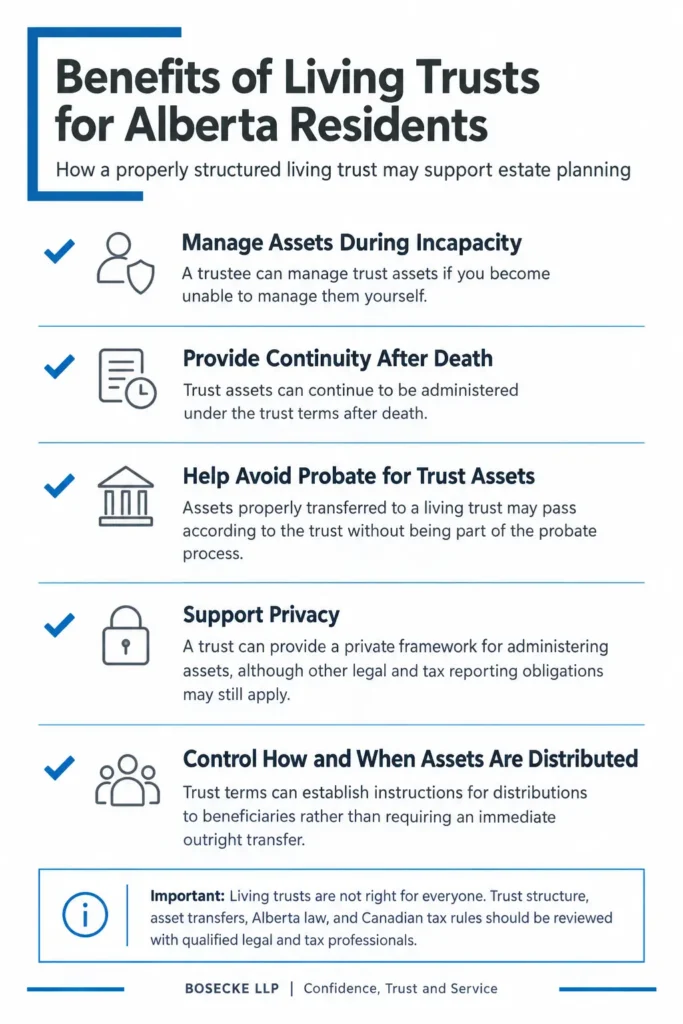
Avoiding probate is often the leading reason families in other provinces such as Ontario and B.C. set up living trusts. In Alberta, our probate fees are flat and capped at $525 regardless of estate size. So if avoiding probate fees is your only goal, a living trust may not deliver much financial benefit.
That doesn’t mean living trusts have no place in Alberta planning. Families here typically use them for other, often more compelling, reasons:
- Privacy. A will becomes a public document once it’s probated. A living trust generally stays private — useful if you’d rather your business dealings, property holdings, or family arrangements not become a matter of public record.
- Incapacity planning. If you become unable to manage your affairs due to illness or injury, a properly structured trust lets your successor trustee step in and manage trust assets seamlessly, without a court application.
- Out-of-province or multiple properties. If you own real estate in more than one province (or country), a living trust can help you avoid multiple, separate probate processes.
- Blended families and complex beneficiaries. Trusts allow much more nuanced control than a will alone — for example, providing for a second spouse during their lifetime while ultimately preserving assets for children from a first marriage.
- Business succession. Holding shares of a private company in a trust can support a smoother transition of control and can be a useful tool in broader succession and tax planning.
- Faster access for beneficiaries. Assets in a living trust can often be distributed more quickly after death than assets tied up in a probated estate.
Living Trust vs. Enduring Power of Attorney in Alberta
| Feature | Living Trust (Inter Vivos Trust) | Enduring Power of Attorney (EPA) |
| Primary Purpose | To hold, manage, and distribute specific assets during your lifetime and after your death, avoiding probate. | To appoint someone to manage your financial and legal affairs on your behalf. |
| When it Takes Effect | Immediately upon being signed and once assets are legally transferred into the trust. | Either immediately upon signing or only after you lose mental capacity (called a “springing” EPA), depending on how it is written. |
| Asset Ownership | Legal ownership of the assets is transferred from you to the trust itself. | You retain full legal ownership of your assets; your appointed Attorney just has the authority to manage them. |
| Scope of Control | The Trustee only has control over the specific assets you have formally transferred into the trust. | The Attorney generally has control over all of your financial assets and property, unless you state specific limitations in the document. |
| Who Manages It | A Trustee (which can be you while you are capable, and an alternate takes over if you become incapacitated). | An Attorney (the person you appoint, not necessarily a lawyer). |
| What Happens at Death | The trust continues. The Trustee distributes the assets to your beneficiaries according to the trust agreement, bypassing your Will and the probate process. | The EPA immediately becomes void and ceases to exist. The executor named in your Will takes over your estate. |
| Cost and Complexity | Setting up a trust is a complex legal process that involves transferring titles/deeds and requires filing separate annual tax returns for the trust. | An EPA is a relatively straightforward legal document that is typically drafted alongside your Will for a standard flat fee. |
| Impact on Probate | Assets in the trust are exempt from the probate process and probate fees. | Does not help you avoid probate; your assets will still go through the standard estate administration process after you die. |
Steps for Setting Up a Living Trust in Alberta
- Define your goals
Privacy, incapacity protection, succession planning, and family complexity all point to different trust structures. This is where working with an Edmonton estate planning lawyer matters most, as the right trust depends entirely on your situation.
- Draft the trust deed
This document names the settlor, trustee(s), and beneficiaries, and sets out how and when trust assets are managed and distributed.
- Choose your trustee carefully
Many Albertans act as their own trustee initially, with a spouse, adult child, or professional named as successor trustee.
- Fund the trust
This is the step people most often overlook. A trust is only effective for assets that are actually transferred into it — retitling property, reassigning investment accounts, or transferring shares. An unfunded trust protects nothing.
- Coordinate with your will
A living trust rarely replaces a will entirely. You’ll still need a will to deal with any assets left outside the trust and to name guardians for minor children, along with powers of attorney and a personal directive for incapacity planning.
- Review and update
Marriage, divorce, new property, or changes in your family should trigger a review of both your trust and your broader estate plan.
Talk to an Edmonton Estate Planning Lawyer About Your Options

Every family’s situation is different, and a living trust is only the right tool when it fits your actual goals. The team at Bosecke LLP has been helping Edmonton, Sherwood Park, St. Albert, and area families build estate plans they can rely on since 1988.
Book a consultation today and let’s map out whether a living trust, a well-structured will, or a combination of both is the right fit for your family and your future.
Answers to Your Frequently Asked Alberta Living Trust Questions
Does a living trust avoid probate in Alberta?
Yes — assets properly transferred into a living trust generally bypass the probate process entirely, since the trust already owns them. However, because Alberta’s probate court filing fees are capped at $525, the fee savings are modest. The stronger reasons to use one in Alberta are privacy, incapacity planning, and control over distribution.
What’s the difference between a living trust and a will?
A will only takes effect after you die and must go through probate before your executor can distribute assets. A living trust takes effect as soon as it’s created and funded, operates during your lifetime, and can continue managing assets seamlessly if you become incapacitated or after you pass away.
Can I avoid capital gains tax by putting my property in a trust?
No. Transferring property into a standard living trust triggers a deemed disposition, meaning you may have to pay capital gains tax immediately. The exception is if you are 65 or older and use an Alter Ego or Joint Partner Trust, which allows the transfer on a tax-deferred basis.
Do I still need a will if I have a living trust?
Almost always, yes. A living trust typically only covers the specific assets transferred into it. You’ll still need a will to deal with anything left outside the trust, appoint an executor, and name guardians for minor children.
How much does it cost to set up a living trust in Alberta?
Costs vary depending on the complexity of your assets, family situation, and goals — a straightforward trust costs less than a trust designed around business succession or a blended family. The best way to get an accurate picture is a consultation where we review your specific assets and objectives.