

When a loved one passes away, emotions are already running high. If they didn’t leave a valid will. a legal status known as dying intestate, the legal process that follows can feel overwhelming. Because there is no will to outline their wishes, Alberta’s Wills and Succession Act takes over to dictate exactly what happens next.
This provincial law applies a strict legal formula to determine who inherits the assets (typically prioritizing a spouse, adult interdependent partner, or children), establishing who has the authority to manage the estate through a Grant of Administration.
Understanding these provincial rules can replace estate law confusion with clarity, helping you make informed, confident decisions during a difficult time.
In this blog, we’ll break down what really happens to an estate with no will, step by step, using plain English. .
What Does “Dying Intestate” Mean?
When someone dies without a will, they are considered to have died “intestate.” This means:
- There is no legal document explaining their wishes.
- The provincial rules set out who gets what and who is allowed to manage their estate.
In Alberta, the Wills and Succession Act guides what happens in these situations.
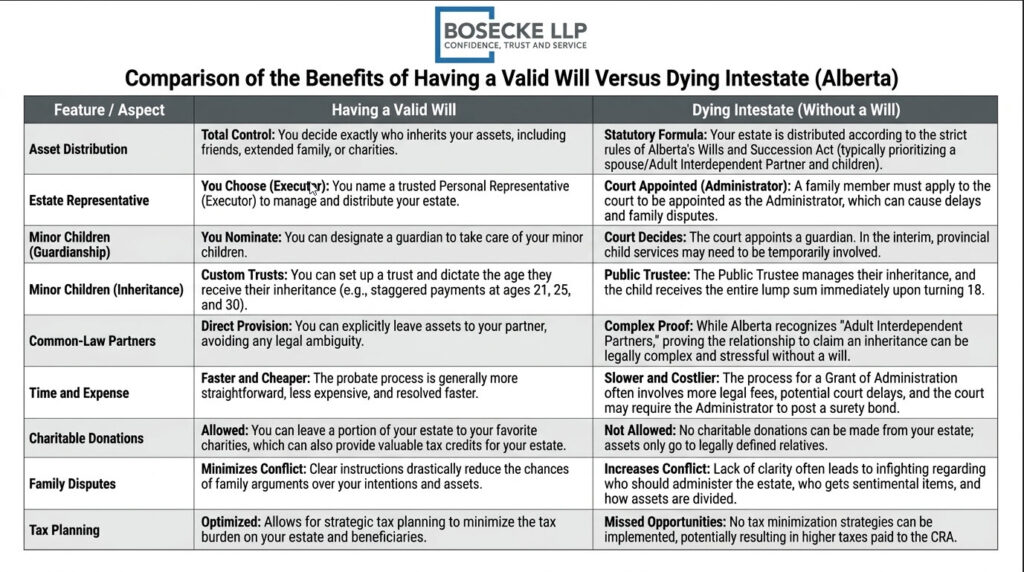
The table below provides an overview of the differences between dying with a will and intestate and how Alberta law handles assets in each scenario.
Who Gets the Estate? Alberta’s Intestacy Rules Explained
If there’s no will, the estate is distributed according to a standard formula. Here’s how it typically works, depending on family circumstances:
1. If there is a spouse or adult interdependent partner (AIP)
- If the deceased has no children: the spouse or AIP inherits everything.
- If the deceased has children with that spouse or AIP: the spouse/AIP still inherits the entire estate.
- If the deceased has children from a previous relationship: the estate is split between the spouse and the children.
This share depends on several factors, including the type of property and its value. A lawyer can help calculate the exact breakdown.
2. If there’s no spouse or AIP
- The estate goes first to any children, divided equally.
- If no children: the estate goes to parents.
- If no parents, the estate moves to siblings.
- If no living siblings: more distant relatives, like nieces, nephews, or cousins.
If no legal heirs can be found, the estate may eventually go to the Government of Alberta.
Who Is Responsible for Managing the Estate Without a Will?
Without a will, no one is officially named to handle the person’s estate. Instead:
- A family member (or other eligible person) must apply to the court to become the administrator.
- The court will review the application to decide who is best suited.
- Once appointed, the administrator has legal authority to manage the estate, pay debts, collect accounts, and distribute assets.
The process takes longer than if a will existed, and certain assets (like jointly owned property or life insurance) may fall outside the estate altogether.
What Documents Are Needed to Apply for Administration?
When stepping in as administrator, you’ll need to submit several documents:
- A formal court application (including a death certificate)
- A full list of the deceased’s assets and debts
- Signed consents from other heirs (if required)
You’ll also need to provide notice to all potential beneficiaries. At Bosecke LLP, we help clients collect and prepare all required paperwork so nothing is missed.
How Long Does the Intestate Process Take in Alberta?
The timeline depends on:
- The size and complexity of the estate
- How easy it is to identify the heirs
- Whether anyone contests the inheritance
In straightforward cases, administration can begin within a few months. However, larger or disputed estates may take a year or more to settle.
Potential Issues When There’s No Will
Not having a will brings added complications:
- Longer times to settle the estate
- Higher legal and administrative costs
- Conflicts among family members over who gets what
- Minor children’s inheritance requires special oversight
In many cases, families are left guessing what the deceased would have wanted. This can strain relationships and increase the emotional toll.
Can You Still Plan Ahead for a Loved One Who Has Passed?
Even without a will, you don’t have to navigate the process alone. A legal advisor can:
- Explain how Alberta law applies to your situation
- Help you apply for administration efficiently
- Ensure the estate is handled fairly and lawfully
We know this can be an emotional time. Our team explains the process in plain terms and answers your questions at every step.
Frequently Asked Questions About Dying Without a Will in Alberta
What if the deceased had assets in another province?
Estates with property in multiple provinces may require additional court applications under that jurisdiction’s rules. A lawyer can guide this.
Can someone challenge Alberta’s default inheritance rules?
Possibly, if an heir believes the default split is unfair or has missed someone, they may go to court. These cases are complex and need legal advice.
What if there is a handwritten or unsigned “will”?
Alberta courts may consider unconventional documents under certain circumstances. Bring any documents to a lawyer to review.
Who takes care of minor children if there’s no will?
Guardianship is not governed by intestacy rules. The court may decide based on the child’s best interest. It’s one more reason wills are so vital.
Do the spouse and AIP have equal rights?
A legally married spouse and a court-recognized Adult Interdependent Partner have similar rights under Alberta’s laws, but timing and circumstances matter.
Avoid the Guesswork In Handling a Loved One’s Estate
If you’re dealing with the estate of someone who died without a will, it can feel like exploring a maze. At Bosecke LLP, our estate planning lawyers provide steady, step-by-step support so you know what’s needed and why.
If you don’t yet have a will of your own, now’s the best time to start. We’ll help you make a plan that’s easy to understand and simple to update as life changes. Give us a call at (825) 819-0310 or schedule a free will drafting consultation.